
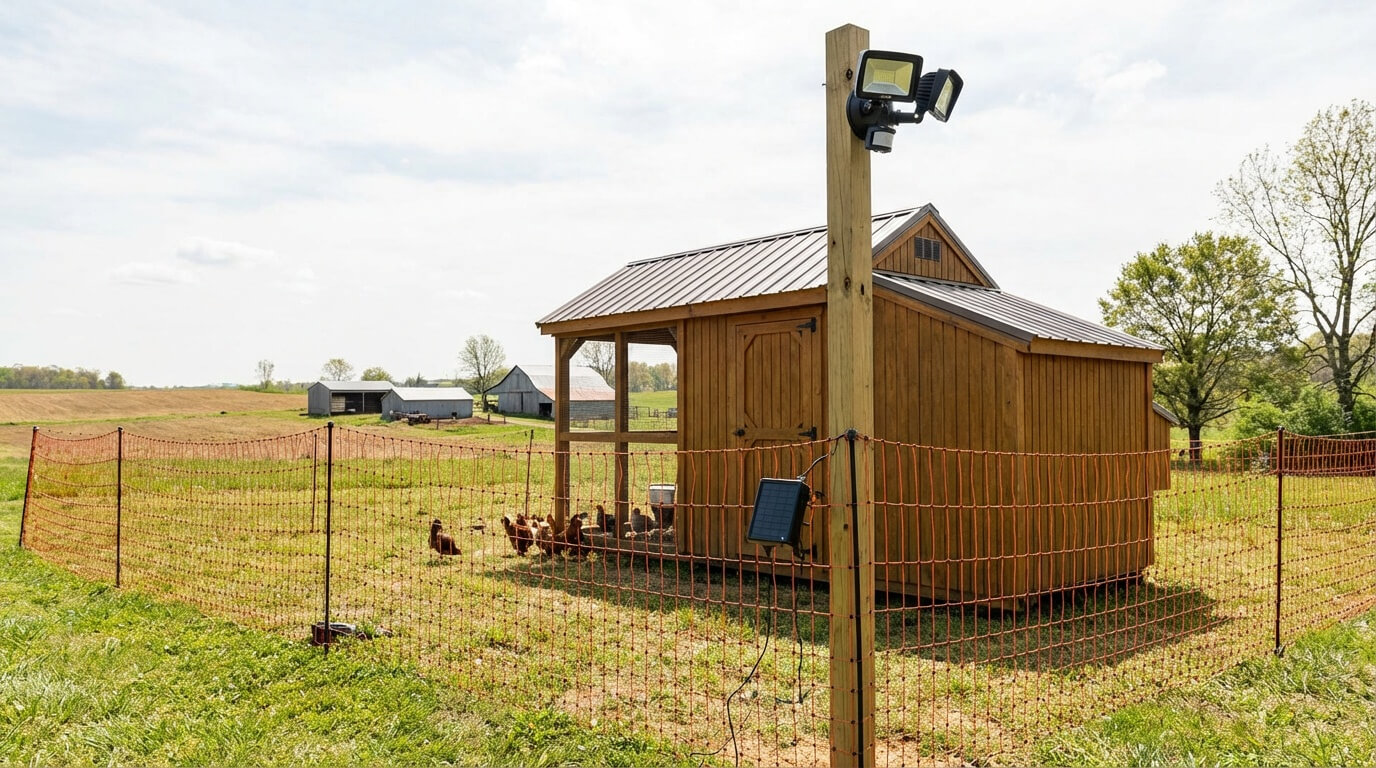
Below are eight evidence-based methods ranchers use to stop coyotes from killing chickens, starting with the most consistently effective.
Coyotes are intelligent, adaptable predators that quickly exploit weak points in poultry setups. Once they identify chickens as an easy food source, losses tend to escalate unless conditions change.
Ranchers and wildlife agencies consistently find that the most reliable way to stop attacks is layered deterrence—using multiple, complementary methods that increase risk, effort, and uncertainty for coyotes. The faster you implement these measures, the better the outcome.
Many poultry losses occur in semi-rural or residential settings where coyotes already navigate human spaces daily, a dynamic explored in Coyotes Near Homes: What Actually Works (and What Doesn’t).
- 1. Electric Poultry Netting (One of the Most Effective Tools)
- 2. Proper Fencing That Stops Digging and Climbing
- 3. Secure Night Coop (Non-Negotiable)
- 4. Guardian Animals (When Matched Correctly)
- 5. Motion-Activated Lighting and Illumination
- 6. Hazing (Effective Early, Less So Once Habituation Sets In)
- 7. Regular Human Presence and Activity
- 8. Remove Attractants That Draw Coyotes In
- Why Layered Deterrents Work Best
- What to Expect, Troubleshooting, and Cost Guidance
1. Electric Poultry Netting (One of the Most Effective Tools)
Electric poultry netting remains one of the most effective non-lethal deterrents available. A brief shock to the nose or paws creates an immediate negative association that most coyotes do not test twice.
Best practices:
- Use poultry-specific electric netting
- Keep vegetation trimmed to prevent grounding
- Ensure proper grounding of the energizer
- Enclose the coop and run, not just the property perimeter
Electric fencing works because it trains avoidance behavior rather than relying on constant human intervention.
2. Proper Fencing That Stops Digging and Climbing

Coyotes can dig under, climb over, and tear through weak fencing. Chicken wire alone is insufficient—it can be chewed, climbed, or ripped open. Fence install with an apron will help stop coyotes from killing chickens.
Ranchers and extension services recommend:
- Fence height: 5–6+ feet to reduce jumping and climbing
- Hardware cloth or welded wire, not chicken wire
- Mesh size: ½” (preferred) or ¼” hardware cloth at the bottom section
- A buried or outward-facing apron extending 12–24 inches to prevent digging
- Reinforced corners and predator-proof gates
Chicken wire may keep birds in, but it does not reliably keep coyotes out.
3. Secure Night Coop (Non-Negotiable)
Allowing birds to free-range after dark dramatically increases predation risk. Coyotes are most active at night, early morning, and dusk.
A secure night coop should include:
- Solid walls and a solid roof
- Tight-fitting doors with predator-proof latches
- No gaps larger than ½ inch
- A solid floor or wire floor with a buried apron
Many poultry keepers now use automatic coop doors, which add reliability by ensuring birds are locked in even if you are late or away.
4. Guardian Animals (When Matched Correctly)
Guardian animals can provide strong deterrence, especially on larger or rural properties.
Common options include:
- Livestock guardian dogs (LGDs)
- Donkeys or llamas for open pasture systems
- Geese as audible early-warning animals
Guardian animals must be well matched to the property and poultry system. Poor training or supervision can create new problems, including poultry loss caused by the guardian itself.

5. Motion-Activated Lighting and Illumination
Coyotes prefer darkness and concealment. Sudden light increases perceived risk and disrupts hunting behavior.
Effective strategies include:
- Motion-activated floodlights around coops and runs
- Low-level continuous lighting near access points
- Periodically changing light placement
Lighting is most effective when paired with fencing and secure housing rather than used alone.
6. Hazing (Effective Early, Less So Once Habituation Sets In)
Hazing works best early, before coyotes become comfortable around humans.
Common hazing tools:
- Loud noises (air horns, shouting, banging metal)
- Flashing or moving visual deterrents
- Reflective tape or hanging objects
Some ranchers use talk radio near coops because natural speech patterns and changing voices create variation, reducing rapid habituation. However, any deterrent must be rotated or altered regularly to remain effective.
Once coyotes lose fear of people, hazing becomes far less reliable.
7. Regular Human Presence and Activity
Coyotes monitor human patterns closely. Areas with consistent activity are treated as higher risk.
Helpful practices include:
- Checking coops at dawn and dusk
- Walking fence lines regularly
- Varying routines and movement patterns
- Addressing damage immediately
Frequent activity reinforces that the area is actively managed rather than unattended.
Coyotes that become comfortable around people are far more likely to test poultry enclosures, a pattern commonly observed in residential and peri-urban areas where food sources and human activity overlap (see Coyotes Near Homes: What Actually Works (and What Doesn’t)).
8. Remove Attractants That Draw Coyotes In
Predation often begins with attractants, not live attacks.
Remove or secure:
- Dead or sick birds (dispose far from the coop)
- Spilled or open feed
- Trash, compost, or pet food
- Dense vegetation near poultry areas that provides cover
If food rewards disappear, coyotes usually shift elsewhere.
Wildlife agencies and ranching organizations consistently emphasize that layered, non-lethal deterrents and attractant removal are the most effective long-term strategies for reducing poultry losses to coyotes, a conclusion supported by guidance from organizations like Project Coyote.
Why Layered Deterrents Work Best

No single method is foolproof. Ranchers consistently report the highest success when physical barriers (electric fencing, secure coops) are combined with behavioral pressure (lighting, hazing, human activity).
Supportive tools like lights and hazing reinforce primary defenses but should not replace them.
Extension services such as Oklahoma State University note that fencing, night confinement, and attractant removal are critical for preventing coyote predation on poultry.
Additional Considerations
- Overhead protection: Netting or roofing over runs reduces losses to hawks and owls and completes predator coverage.
- Regional pressure: In areas with dense coyote populations, electric fencing combined with guardian animals is often necessary. Basic wire fencing alone may fail.
What to Expect, Troubleshooting, and Cost Guidance
How Quickly Do These Methods Work?
Most poultry keepers who install electric fencing and secure night housing notice reduced coyote activity within a few days to two weeks. In many cases, tracks and sightings drop almost immediately once coyotes receive a negative stimulus from electric netting.
However, in areas where coyotes are already habituated to human activity, it may take several weeks for them to abandon a location entirely. Consistency is critical—deterrents that are removed too early often result in repeat losses.
If Losses Continue Despite Improvements
If chickens are still being taken after deterrents are installed, the issue is usually a weak point rather than overall failure.
Common troubleshooting steps include:
- Inspecting electric fences for grounding issues or vegetation contact
- Checking for gaps under gates, corners, or coop edges
- Reinforcing latches and door seams
- Increasing night confinement during high-risk periods
- Rotating lights or hazing tools to prevent habituation
In persistent cases, local extension services or wildlife agencies can often provide site-specific recommendations based on regional predator pressure.
Seasonal Adjustments to Keep in Mind
Predation pressure is not constant year-round.
Losses often increase:
- Late winter, when natural prey is scarce
- Spring and early summer, when coyotes are feeding pups
- During droughts or severe weather that reduce prey availability
During these periods, it is especially important to maintain electric fencing, limit free-ranging, and double-check coop security.
Cost Guidance: What to Budget For
Costs vary widely depending on flock size, property layout, and existing infrastructure, but most solutions fall into three general tiers.
Low-cost improvements ($25–$100):
- Hardware cloth reinforcement
- Predator-proof latches or carabiners (Amazon Affiliate)
- Removing attractants and improving sanitation
- Basic lighting adjustments
Moderate investment ($150–$400):
- Electric poultry netting and energizer (Amazon Affiliate)
- Motion-activated lights
- Automatic coop doors
- Fence apron materials
Higher investment ($500+):
- Permanent electrified fencing systems
- Livestock guardian animals
- Structural coop rebuilds or covered runs
Many poultry keepers find that starting with electric netting and a secure night coop provides the highest return for the lowest long-term cost.
Staying Committed Pays Off
Coyotes are opportunistic but risk-averse. When deterrents are consistent and layered, most will abandon a site rather than expend energy testing defenses.
Understanding how to stop coyotes from killing chickens is not about eliminating predators—it’s about removing opportunity. With patience and proper setup, poultry losses can be reduced dramatically without escalating to lethal control.
Leave a Reply