
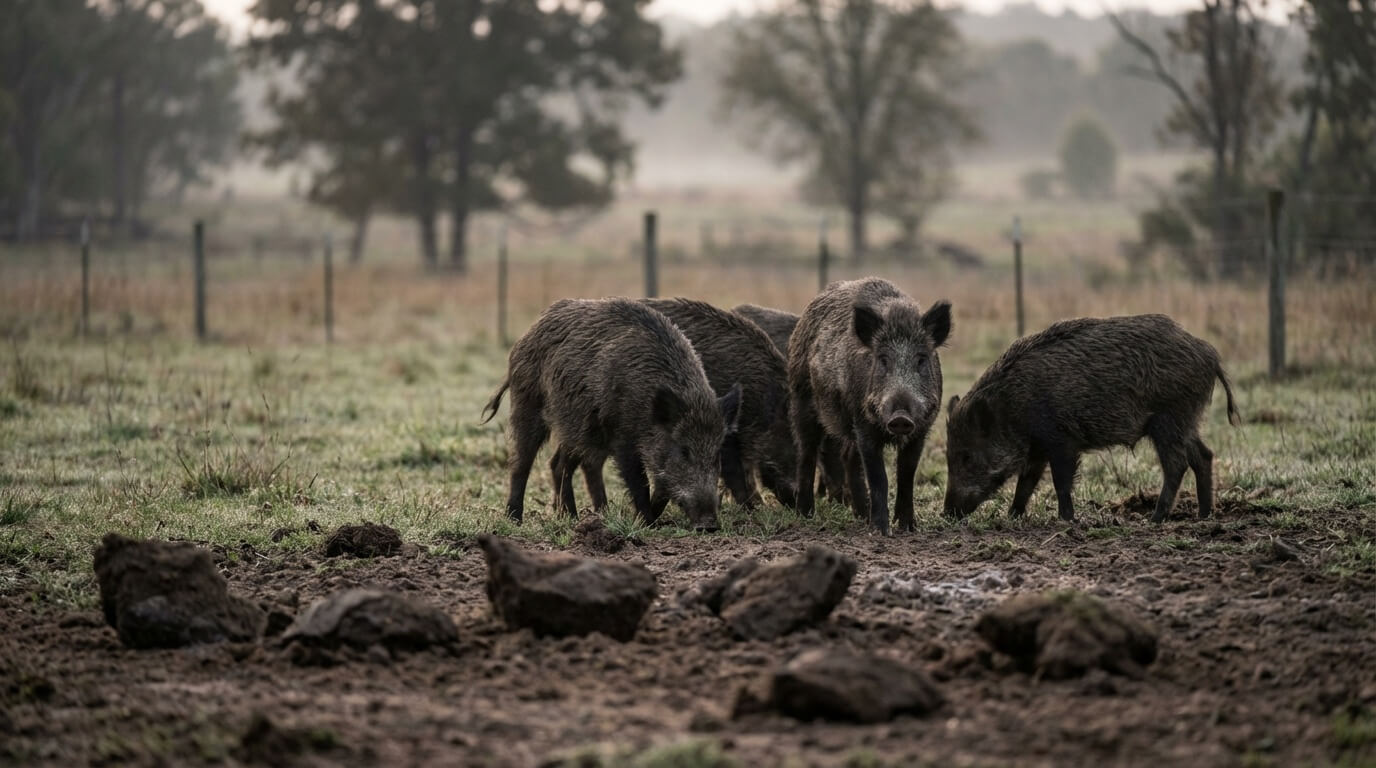
A Texas ranch spent thousands of dollars removing dozens of feral hogs over several months.
The following year, trail cameras showed more hogs than before.
That outcome isn’t unusual. It’s typical.
Feral hogs are not a nuisance you “dabble” against. They are intelligent, fast-breeding, and extremely good at exploiting half measures. When control efforts are incomplete or inconsistent, hogs don’t just persist — they expand.
Single-method solutions fall short.
Short-term effort backfires.
Partial removal almost always makes the problem worse.
This guide explains what actually works, why most attempts fail, and what realistic success looks like.
Table of Contents
Why Most Feral Hog Control Fails

Most hog control fails for one reason: some hogs are removed instead of most hogs.
Common examples:
- Weekend hunting
- Trapping a few animals and stopping
- “We shot several — that should help”
Biologically, this is the worst possible approach.
Feral hogs live in family groups called sounders, led by breeding females. When those groups are disrupted but not eliminated, studies show populations rebound rapidly due to a combination of residual animals, immigration, and compensatory reproduction.
With the ability to produce 4–6 piglets per litter and up to two litters per year under favorable conditions, even a small number of surviving hogs can replace a year’s removal effort faster than most landowners expect.
This is the partial-removal paradox:
reducing numbers without breaking reproductive capacity accelerates damage.
Well-meaning efforts don’t just fall short — they often make the problem worse.
Methods Ranked by Effectiveness
Not all hog control methods perform equally. Below is a realistic ranking, from most effective to least, based on wildlife agency guidance and peer-reviewed field studies.
Whole-Sounder Trapping (Corral Traps and Drop Nets)

What it does
Removes entire family groups at once — commonly 10–30 hogs, including breeding females.
Why it works
Research consistently shows that whole-sounder removal reduces rebound far more effectively than traditional trapping or hunting.
What “done right” means
- Traps large enough for the entire sounder
- Pre-baiting without triggering for days or weeks
- Remote or delayed triggering so all hogs enter before capture
When it fails
Triggering traps too early simply recreates the partial-removal problem.
This is the most reliable ground-based control method available.
Coordinated Removal Over Time
What it does
Applies sustained pressure across a landscape until populations stabilize at lower levels.
Why it works
Hogs adapt quickly to isolated pressure but struggle against persistent, coordinated effort.
Coordination often starts simply: sharing trail-camera data, comparing damage reports, or agreeing to trap or remove hogs during the same windows so animals cannot rotate between properties. Wildlife agencies routinely recommend neighbor cooperation to increase effective control area and reduce rebound.
When coordination breaks down, hogs don’t disappear — they just shift the problem next door.
Aerial Removal (Where Legal)
What it does
Rapidly removes large numbers of hogs across large, open landscapes.
Why it works
It bypasses hog wariness and dense ground cover that limit ground-based methods.
Cost reality
When conducted at scale in suitable terrain, reports commonly cite effective per-hog costs in the $100–$300 range, though results vary widely by hog density, vegetation, access, and region. In ideal conditions, some programs document even lower costs; in poor conditions, costs rise quickly.
Limitations
- Requires open terrain and favorable weather
- Survivors adapt quickly, shifting activity and space use
- Effectiveness declines without follow-up pressure
Aerial removal works best as part of multi-year, coordinated programs, not one-time operations.
Night Hunting and Thermal Hunting

What it does
Removes individual hogs during low-light conditions.
Where it helps
- Targeting specific animals
- Supplementing trapping or aerial removal
Why it falls short
- Rarely removes entire sounders
- Quickly educates surviving hogs
- Effectiveness declines over time
Useful as a support tool — ineffective as a stand-alone strategy.
Fencing (Damage Prevention, Not Population Control)
What it does
Protects specific, high-value areas such as feeding stations, gardens, or sensitive infrastructure.
Reality check
- Exclusion fencing can cost thousands of dollars per mile, depending on materials and terrain
- Electric fencing is cheaper but requires regular maintenance
- Fencing does not reduce hog populations
Fencing treats symptoms, not causes, and often shifts damage elsewhere.
| Method | Effectiveness | Pros | Cons | Approximate Cost |
|---|---|---|---|---|
| Whole-Sounder Trapping (Corral traps / Drop nets) | Highest (ground-based) | Removes entire family groups (10–30+ hogs); minimizes rebound; most reliable for population reduction | Requires pre-baiting (days–weeks), large traps, and correct triggering; early trigger recreates partial removal | ~$500–$2,000 initial setup (panels, posts, gate/camera); low ongoing |
| Coordinated Removal Over Time (Multi-property effort) | Very High (landscape-scale) | Sustained pressure limits adaptation and immigration; essential for lasting control | Requires neighbor cooperation and persistence; hog activity may shift temporarily | Varies (depends on methods used); often less than recurring damage long-term |
| Aerial Removal (Helicopter gunning, where legal) | High (rapid reduction) | Removes large numbers quickly; bypasses cover and hog wariness in open terrain | Legal, terrain, and weather constraints; survivors adapt; requires follow-up | Commonly ~$100–$300 per hog at scale; varies widely by conditions |
| Night / Thermal Hunting | Moderate (supplemental) | Targets individuals at night; useful for specific animals; recreational appeal | Rarely removes entire sounders; educates survivors quickly; effectiveness declines | Equipment ~$1,000–$10,000+ (thermals); low ongoing |
| Fencing (Exclusion: electric, mesh, panels) | Low (damage prevention only) | Protects high-value areas (feeders, gardens, infrastructure) | Does not reduce populations; shifts damage elsewhere; maintenance required | Often thousands per mile depending on materials/terrain; electric options cheaper |
What Science and Wildlife Agencies Agree On
Across regions, wildlife agencies consistently reach the same conclusions:
- High annual removal percentages are required to suppress populations
- Eradication is rarely realistic without sustained effort
- Partial removal accelerates rebound
- Persistence matters more than tactics
Feral hogs demand long-term management, not quick fixes.
What Landowners Should Expect
Realistic Timelines
- Short-term disruption: weeks
- Measurable reduction: months
- Lasting control: ongoing effort
Cost Reality
Effective control costs more than casual hunting, but often less than repeated crop, pasture, and infrastructure damage.
Behavioral Changes Under Pressure
- Survivors become harder to encounter
- Hog activity may shift to neighboring areas before stabilizing
This does not signal failure. It signals adaptation under pressure.
What Success Actually Looks Like
Real success is not “no hogs.”
It looks like:
- Fewer tracks and wallows
- Reduced rooting damage
- Trail cameras showing sporadic, not nightly, activity
Control is measured in stability, not elimination.
Why This Matters Beyond Property Damage
Feral hogs also pose disease and safety risks, including brucellosis and pseudorabies, particularly during handling or field dressing. Even moderate infestations carry consequences beyond property damage.
Final Takeaway
Treat feral hogs like the long-term management challenge they are — or accept that you’re just rearranging the problem.
References & Further Reading
- Gaskamp, J. A., Gee, K. L., Campbell, T. A., Silvy, N. J., & Webb, S. L. (2021). Effectiveness and Efficiency of Corral Traps, Drop Nets and Suspended Traps for Capturing Wild Pigs (Sus scrofa). Animals : an open access journal from MDPI, 11(6), 1565. https://doi.org/10.3390/ani11061565
- Kilgo, J. C., Vukovich, M., Cox, K. J., Larsen, M., Mims, T. T., & Garabedian, J. E. (2023). Assessing whole-sounder removal versus traditional control for reducing invasive wild pig (Sus scrofa) populations. Pest management science, 79(9), 3033–3042. https://doi.org/10.1002/ps.7478
- USDA APHIS.
Feral Swine Biology, Damage, and Management.
https://www.aphis.usda.gov/aphis/ourfocus/wildlifedamage/operational-activities/feral-swine - Texas A&M AgriLife Extension.
Coping With Feral Hogs.
https://feralhogs.tamu.edu/ - Oklahoma Department of Wildlife Conservation.
Controlling Feral Hogs.
https://www.wildlifedepartment.com/hunting/feral-hogs/controlling - Texas A&M Natural Resources Institute (2025).
Using Exclusion Fencing to Prevent Feral Hog Access at Feeding Stations.
https://nri.tamu.edu/blog/2025/december/using-exclusion-fencing-to-prevent-feral-hog-access-at-feeding-stations/ - Centers for Disease Control and Prevention (CDC).
Feral Swine and Zoonotic Disease Risks.
https://www.cdc.gov/brucellosis/exposure/animals/feral-swine.html
Leave a Reply