
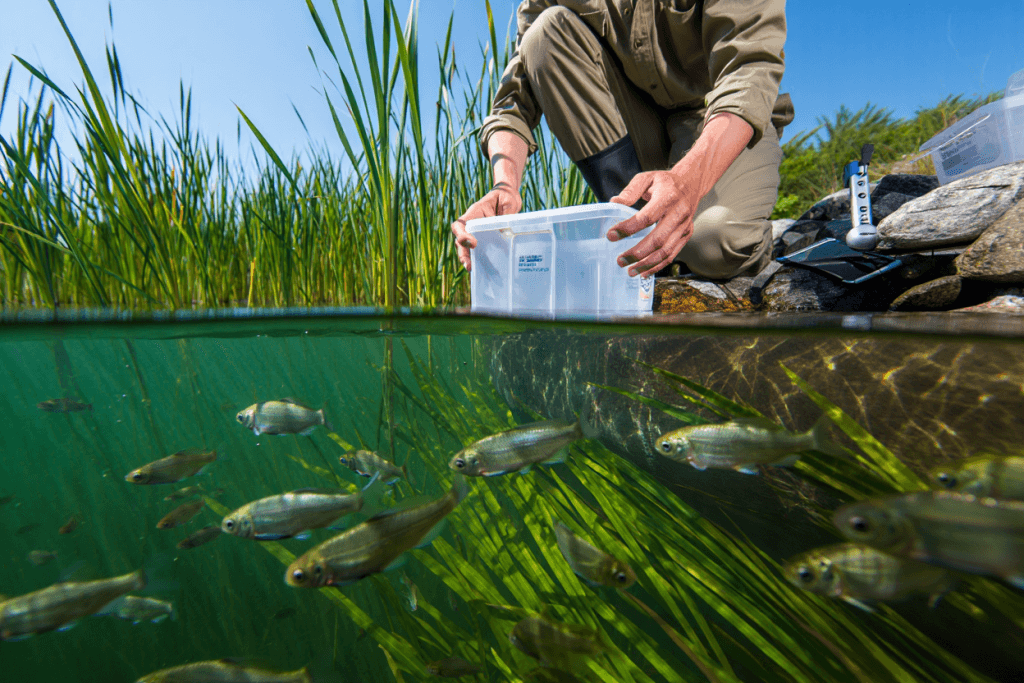
Environmental DNA—usually shortened to eDNA—has become one of the most talked-about tools in invasive species monitoring. It’s faster than netting, quieter than cameras, and often detects species long before anyone sees a body.
That matters when the species in question is something like feral hogs creeping into a watershed or zebra mussels hitchhiking their way into a private lake. Early detection can mean the difference between targeted control and years of damage control.
But eDNA is also one of the most misunderstood tools now in use by landowners, wildlife agencies, and conservation districts.
Here’s the reality up front:
eDNA is a flashlight—not a silver bullet.
It illuminates where invasive species might be hiding, but you still need other tools to confirm what you’re seeing and decide what to do about it.
Used correctly, eDNA can save time, money, and political capital.
Used poorly, it can trigger false alarms, neighbor disputes, and stalled management plans.
This guide explains what eDNA actually does, what it costs in 2026, who can use it, and how to integrate it into real-world invasive species management without overpromising or fooling yourself.
Table of Contents
I. What Is eDNA?
Environmental DNA refers to genetic material that organisms shed into their surroundings through skin cells, waste, mucus, gametes, or decaying tissue. In aquatic systems, this DNA accumulates in water and sediment. In some cases, it can also be detected in soil or snow.
An eDNA test does not capture the organism itself. Instead, it detects short DNA fragments that indicate a species was present recently.
What eDNA can tell you:
- Whether a target species’ DNA was present in a sampled area
- Whether a species is likely present at very low density
- Whether a previously removed species may have returned
What eDNA cannot tell you:
- How many individuals are present
- Whether they are reproducing
- Where, exactly, the organism is located
- Whether the population is established or transient
That limitation matters. Many management failures involving eDNA stem from assuming it provides certainty when it actually provides direction.
Think of eDNA as a scouting tool. It narrows the search area. It does not finish the job.
eDNA fits within a broader wildlife monitoring technology overview that includes cameras, drones, acoustics, and physical surveys, each with distinct strengths and limitations.
II. What Is eDNA Used For in Invasive Species Management?
In practice, eDNA is used in three primary ways.
🔍 Early Detection
🚩 High-Risk Entry Points
🔁 Post-Removal Checks
Early Detection
eDNA often detects invasive species at densities too low for nets, traps, or visual surveys. This is especially valuable for species like grass carp, zebra mussels, New Zealand mud snails, or invasive crayfish, where early response dramatically reduces control costs.
Surveillance of High-Risk Locations
Agencies and land managers use eDNA at:
- Farm ponds and reservoirs
- Irrigation canals
- Boat ramps and marinas
- Tributaries downstream of known infestations
Rather than surveying entire watersheds, eDNA allows targeted screening of likely entry points.
Post-Removal Monitoring
After eradication or suppression efforts, eDNA is increasingly used to verify whether a species is truly gone—or whether reinvasion has occurred.
Importantly, most agencies do not use eDNA alone to declare success. It’s used to guide follow-up monitoring.
III. The Chain of Custody: Why Your Sample Is Only as Good as Your Cleanliness

Most eDNA failures do not happen in the lab.
They happen in the field.
From collection to analysis, every step in the sampling chain introduces risk. A contaminated sample processed by a certified lab is still a contaminated sample.
The Basic Sampling Chain
- Water or sediment is collected
- Material is filtered to capture DNA fragments
- Filters are preserved and shipped
- DNA is extracted and analyzed in a lab
Break the chain at any point, and your result becomes unreliable.
Why Contamination Is the #1 Failure Mode
eDNA assays are extremely sensitive by design. That sensitivity is what allows early detection—but it also means tiny amounts of foreign DNA can trigger false positives.
If you wouldn’t lick your gloves, don’t touch the filter.
That single rule will prevent more bad data than any lab protocol.
How eDNA Samples Get Ruined in the Real World
Common contamination sources include:
- Bait buckets or livewells used in multiple waterbodies
- Waders, boots, or nets moved between sites
- Boat bilges, anchors, and trailers
- Handling filters with dirty gloves
- Sampling downstream of cleaning stations or fish-handling areas
Contamination remains the most common source of false positives in eDNA surveys, particularly when field protocols are not strictly followed.
The Disposable Rule (2026 Update): Why Reusing a $2 Bucket Can Cost You a $2,000 Management Plan
By 2026, most practitioners have moved away from open-air filter papers toward encapsulated filter capsules.
These sealed units allow water to be pumped directly through a closed housing. The filter is never exposed to air, hands, or gear. Once sampling is complete, the entire unit is sealed and shipped.
Disposable, encapsulated filters are cheap insurance against false positives that can derail a management plan worth thousands of dollars. Saving a few dollars by reusing gear is one of the fastest ways to generate results agencies may hesitate to trust or act on.

The eDNA “Zero-Contamination” Checklist
Headed into the field? Download this one-page checklist to reduce false positives and collect samples agencies are more likely to trust.
IV. Best eDNA Testing Approaches for Invasive Species (By Goal, Not Brand)
There is no single “best” eDNA test. The right approach depends on what you’re trying to answer.
Species-Specific qPCR

This method targets one species at a time using primers (small, GPS-like molecules that bind to specific DNA sequences).
Best used when:
- You are monitoring a known high-risk invasive
- You need high sensitivity at lower cost
- The management question is binary (present / not detected)
Metabarcoding
Metabarcoding sequences DNA from many organisms simultaneously.
This approach used to be prohibitively expensive. By 2026, AI-assisted lab pipelines have cut costs dramatically—what once ran $2,000 per sample is now often $500–$1,200.
Best used when:
- You don’t know what species might be present
- You’re surveying ports, reservoirs, or entire watersheds
- You want early warning for unexpected invaders

Because metabarcoding relies on reference databases, rare species or incomplete libraries can still produce weak or ambiguous signals that require confirmation with targeted testing or field surveys.
Multi-Marker Strategies
Many agencies now combine methods—using metabarcoding to scout broadly, then species-specific qPCR for confirmation.
Practitioner Decision Matrix
Use this table to choose an approach based on your goal—not marketing claims.
| If your goal is… | Use this method | Because… |
|---|---|---|
| Confirm presence of a known threat | Species-specific qPCR | High sensitivity, lower cost ($200–500/sample) |
| Survey a watershed for unknown invaders | Metabarcoding | Detects 100+ species per sample |
| Monitor eradication success | Multi-marker qPCR + visual surveys | DNA suggests absence; visuals verify no reproduction |
| General bio-surveillance (“What’s in my water?”) | Metabarcoding | Catches “ghost” species you weren’t looking for |
V. Detection Accuracy, False Positives, and DNA Transport
DNA Persistence (2026 Consensus)
In most rivers, ponds, and farm reservoirs relevant to land managers, environmental DNA degrades within 24–48 hours. In flowing or warm freshwater systems, environmental DNA typically degrades rapidly, often within one to two days, depending on temperature, flow, and microbial activity. Temperature, UV exposure, flow rate, and turbidity all influence this window.
In colder, still, or sediment-rich environments DNA can persist longer, but in most managed rivers, ponds, and reservoirs the actionable window for confirmation is short.
A positive detection usually means the organism was present very recently—likely yesterday, not weeks ago.
Actionable takeaway:
If you receive a positive result, act quickly. The window for confirmation surveys, camera deployment, or trapping is measured in days—not weeks.
Transport Effects
DNA can move downstream. In flowing water, a positive detection does not always mean the organism is located exactly where the sample was taken. This is why agencies rely on spatial replication and follow-up surveys.
Evidence Brief: Early Detection in Practice (Illustrative Scenario)
Scenario based on U.S. Geological Survey early-detection protocols in Midwestern watersheds.
- eDNA detected in April at a reservoir inflow
- Follow-up surveys initiated within 72 hours
- First physical confirmation recorded in October
- Early detection allowed targeted control instead of watershed-wide restrictions
This scenario is illustrative, not a specific event, but it reflects standard agency response timelines.
VI. eDNA Testing for Invasive Species: Cost, Access, and Timing
Typical Cost Ranges (2026)
- Single-species tests: $150–$400 per sample
- Metabarcoding: $500–$1,200 per sample
Actual prices vary by lab, sample volume, turnaround time, and whether kits and shipping are included, so always check current quotes before committing to a monitoring plan.
Costs usually include collection kits, shipping, and lab analysis.
| Method | Cost | Speed | Certainty |
|---|---|---|---|
| eDNA | $$ | Slow–Medium | Presence |
| Cameras | $$$ | Medium | ID & behavior |
| Trapping | $$$$ | Fast | Physical proof |
Can Private Landowners Order eDNA Tests?
Yes. In 2026, private landowners can order eDNA kits from commercial laboratories that accept citizen samples.
What you typically receive:
- Collection kit
- Instructions
- Pre-paid shipping
- Lab report (usually within 2–4 weeks)
Many labs now provide short training guides or videos for first-time users, and using them is often the difference between a result agencies trust and one that does not meet their evidentiary thresholds.
Important caveat:
A DIY positive does not trigger enforcement or eradication.
It starts a conversation with your state wildlife agency.
Some labs also offer anonymous reporting options. This matters. Many landowners hesitate to test because they fear a positive result will trigger a government-mandated quarantine of their private lake. Knowing your reporting options ahead of time helps manage that risk.
The Waiting Game: Why Turnaround Time Matters
Standard lab turnaround is 2–4 weeks after sample receipt.
For fast-spreading invasives like feral hogs, hydrilla, or grass carp, that delay can matter.
By 2026, some labs offer 48-hour “Hot Sample” processing at 150–200% of standard cost.
Decision rule:
- Active spread or emergency response → pay for speed
- Routine surveillance → standard turnaround is fine
VII. The Toolkit Approach: Using eDNA to Scout Where Other Tools Should Go
eDNA works best when it guides other monitoring tools instead of replacing them.
The Integrated Monitoring Loop
- eDNA detection flags a zone of concern
- Camera deployment confirms species identity and behavior
- Targeted trapping or removal measures density and reduces numbers
- Follow-up eDNA verifies removal success
- Repeat or expand to new zones
Once eDNA narrows your search area, deploy camera traps to confirm species identity and behavior, or use drone surveys to map habitat suitability across the flagged zone. For aquatic species, pairing eDNA with acoustic monitoring can help detect spawning activity or seasonal movement.
In larger or inaccessible areas, drone surveys for wildlife populations help managers map habitat suitability and movement corridors across the zone flagged by eDNA results.

This approach saves time while preserving credibility.
VIII. When eDNA Results Create Conflict—and How to Handle It
A. The False Positive Conflict
A landowner’s test shows an invasive species.
The county says there hasn’t been a confirmed sighting in years.
This tension is common. Agencies hesitate to act on single detections because false positives carry legal and political consequences.
B. The Body Requirement (and the Two-Positive Rule)
Many wildlife codes still require physical specimens for official action.
By 2026, most states follow an informal Two-Positive Rule:
- Two independent eDNA positives from different locations, or
- One eDNA positive followed by visual or physical confirmation
eDNA is treated as probable cause, not proof.
Pro-Tip:
If you get a positive result, don’t just re-test the exact same spot. Move 50 yards upstream or sample from a different bank. Two positives from different locations carry far more weight with agency officials when deciding whether follow-up action is warranted.
Also important: Save your negative reports. A clean history followed by a new positive is far more persuasive than a single isolated test. Document dates, locations, methods, and weather conditions.
Agencies are more likely to act when eDNA positives are followed by confirmation through camera trap monitoring for invasive species or other physical survey methods.
C. The Citizen-to-Agency Pipeline
A growing number of states now offer online portals where landowners can submit eDNA results alongside photos and GPS coordinates. A private test often becomes the trigger for agency resampling, expanded surveillance, or cost-share control programs.
Think of eDNA as a way to get on the agency’s radar—not to bypass it.
IX. What Changed for Landowners and Agencies (2024–2026)
- Standardized field protocols are now widely referenced
- Citizen access to testing has expanded rapidly
- Online reporting infrastructure is becoming common
- Legal acceptance of eDNA as “probable cause” is increasing, though uneven
In practical terms, what once required university lab access can now be done by landowners with shipped kits and basic field discipline.
X. Key Takeaways: Use the Flashlight, Don’t Worship It
- eDNA shows you where to look, not what to do next
- Clean sampling beats fancy technology every time
- Best results come from integrated monitoring
- A positive test starts a conversation—not an eradication program
Final word:
eDNA won’t kill a single feral hog or pull a single pound of hydrilla. It just tells you where to aim the truck. Use it to save time and money—not to replace boots on the ground.
Frequently Asked Questions
eDNA testing is used for early detection and surveillance. It helps identify where invasive species may be present so managers know where to focus cameras, trapping, or follow-up surveys. It is not used as standalone proof for enforcement or eradication.
eDNA testing is highly sensitive and often detects species at very low densities. However, accuracy depends heavily on sampling design, contamination control, and environmental conditions. Positive results usually require confirmation through additional sampling or traditional survey methods.
In most managed rivers, ponds, and reservoirs, environmental DNA degrades within 24–48 hours, especially in warm or flowing conditions. In colder, still, or sediment-rich environments, DNA may persist longer, which is why results must be interpreted carefully.
Yes. In 2026, several commercial laboratories offer eDNA testing kits to private landowners. A positive result does not trigger enforcement—it starts a conversation with state wildlife agencies about next steps and potential follow-up sampling.
Most agencies require confirmation before taking action. A single positive eDNA detection is treated as a screening signal, not proof of establishment. Many agencies follow a “two-positive” or confirmation standard using repeat sampling or physical evidence.
References
Coble, A. A., Flinders, C. A., Homyack, J. A., Penaluna, B. E., Cronn, R. C., & Weitemier, K. (2019).
Environmental DNA as a tool for identifying freshwater species in sustainable management. Science of the Total Environment, 647, 1159–1170.
Goldberg, C. S., Turner, C. R., Deiner, K., Klymus, K. E., Thomsen, P. F., Murphy, M. A., Spear, S. F., McKee, A., Oyler-McCance, S. J., Cornman, R. S., Laramie, M. B., Mahon, A. R., Lance, R. F., Pilliod, D. S., Strickler, K. M., Waits, L. P., Fremier, A. K., Takahara, T., Herder, J. E., & Taberlet, P. (2016).
Critical considerations for the application of environmental DNA methods to detect aquatic species. Methods in Ecology and Evolution, 7(11), 1299–1307.
https://doi.org/10.1111/2041-210X.12595
Rees, H. C., Maddison, B. C., Middleditch, D. J., Patmore, J. R. M., & Gough, K. C. (2014).
The detection of aquatic animal species using environmental DNA—A review of eDNA as a survey tool. Biological Conservation, 183, 4–18.
U.S. Fish and Wildlife Service. (2022).
Environmental DNA (eDNA) best management practices.
https://www.fws.gov/library
U.S. Geological Survey. (n.d.).
Environmental DNA (eDNA): Applications for invasive species early detection.
https://www.usgs.gov
Leave a Reply