
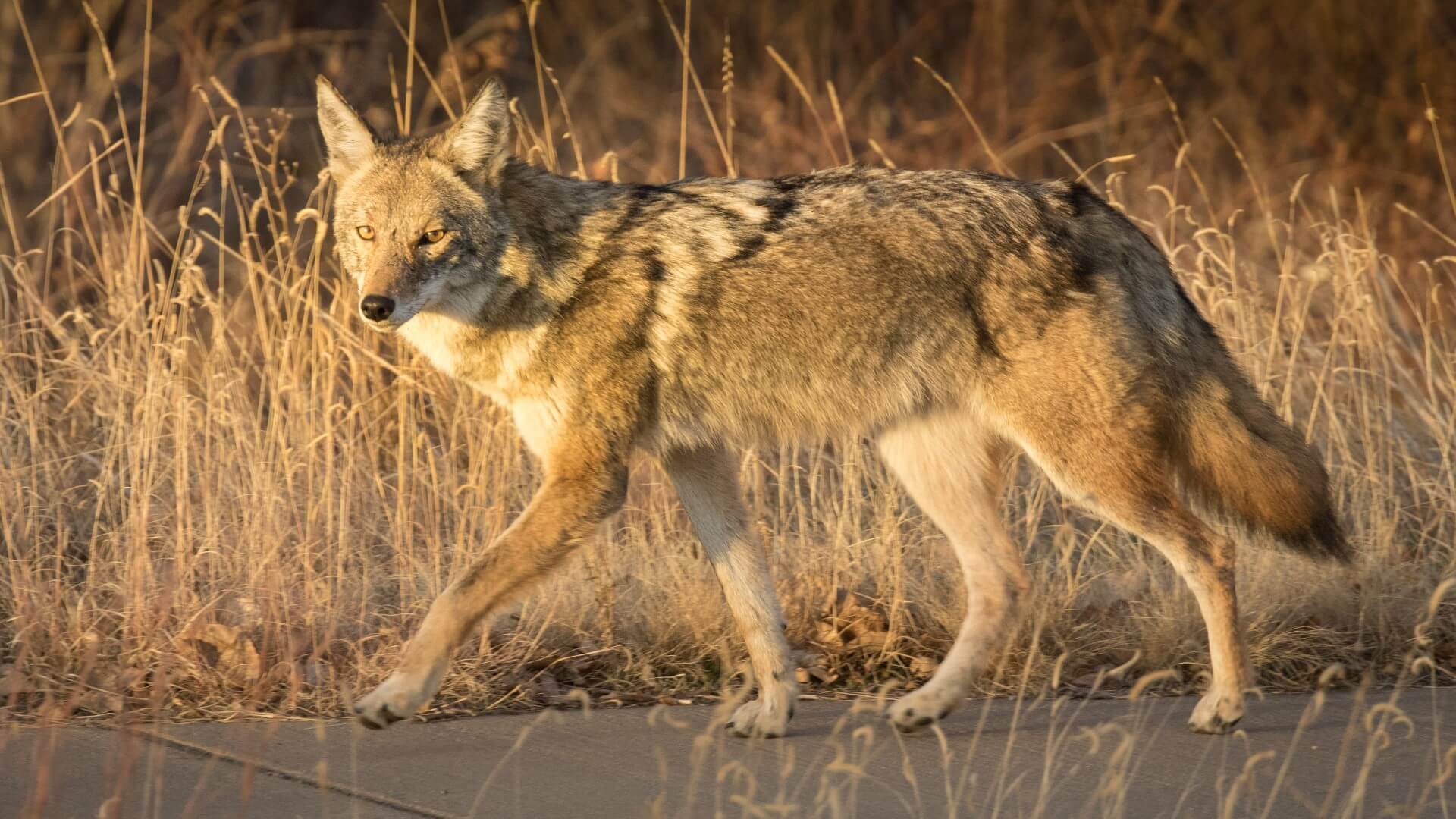
Across much of the United States, drought is no longer just a background climate condition—it is actively reshaping where wildlife lives and how often people encounter it. As of January, 15th 2026, the latest U.S. Drought Monitor shows that while some western areas have improved, roughly 37–45% of the contiguous U.S. remains under drought conditions, with widespread snow drought compounding water scarcity into spring and summer.
Those dry conditions are not staying confined to rangelands or forests. In San Francisco, coyotes were filmed playing near the Golden Gate Bridge. In Las Vegas, residents captured videos of coyotes roaming residential streets. Across Southern California, sightings have spiked as breeding season approaches and animals travel farther for food and mates. These are not isolated incidents—they’re part of a measurable pattern.
Recent peer-reviewed research, reinforced by federal drought monitoring data, documents how drought wildlife conflict rates increase as precipitation drops: reports of encounters with adaptable carnivores like coyotes, mountain lions, bobcats, and black bears rise consistently and measurably. In California alone, more than 31,900 conflict reports were documented over just seven years. Related coverage from UC Davis News reports that drought years consistently see higher public reporting of wildlife encounters as animals travel farther in search of water and reliable food sources. The trend is not anecdotal. It is statistically robust—and increasingly relevant as drought cycles intensify.
Key Takeaway
- Drought acts as a conflict multiplier.
Water scarcity and prey compression drive wildlife into human-dominated spaces, leading to predictable increases in reported encounters during dry years.
Table of Contents
- The Pattern Showing Up During Drought Years
- What the Research Actually Shows
- How Drought Pushes Wildlife Toward Cities
- Federal Monitoring Confirms the Trend
- Why Carnivores Show the Strongest Signal
- This Is Not Just a California Issue
- What This Means for Communities
- The Bottom Line
- FAQ
- References
The Pattern Showing Up During Drought Years
Urban wildlife sightings often spike during dry periods, and early 2026 has been no exception. Cities across the West and Pacific Northwest have reported increased encounters with coyotes in parks, greenbelts, and residential neighborhoods. While these incidents may feel sudden to residents, the underlying driver is neither mystery nor population explosion.
Drought alters landscapes faster than animals can adapt in place. When water and prey become scarce across large areas, wildlife does what it has always done: it moves.
What is new is where the most reliable resources now exist—and increasingly, that is within human-dominated environments.
What the Research Actually Shows
Quantified Increases in Conflict Reports
A late-2025 study published in Science Advances analyzed over 31,900 human–wildlife conflict reports from the California Department of Fish and Wildlife alongside seven years of precipitation records. The results were clear and consistent across species.
For every one-inch decline in annual precipitation:
- Coyote conflict reports increased by ~2.2%
- Mountain lion incidents increased by ~2.1%
- Black bear encounters increased by ~2.6%
- Bobcat conflicts increased by ~3.0%
The strongest increases occurred during multi-year drought periods, not isolated dry seasons. While the dataset focused on California, the authors note that this relationship is expected in other drought-prone regions with Mediterranean-like climates or pronounced seasonal water variability.
Reporting Bias vs. Real Encounters
The study also addresses an important caveat: “conflict” is defined through public reporting. Not every report represents physical harm or direct interaction. Some reflect sightings or perceived threats.
That distinction does not weaken the finding. Even if drought heightens public sensitivity to wildlife presence, management demand still rises, agency response costs still increase, and animals are still occupying closer proximity to people. From a land-use and public-safety standpoint, reporting volume itself is a meaningful signal.
📊 What Counts as a “Conflict”?
Most reported conflicts involve nuisance encounters—sightings that cause concern, property damage such as trash raids, or threats to pets or livestock. Direct attacks on people remain rare.
However, reporting volume still matters: it reflects real management pressure, agency response costs, and increasing proximity between wildlife and humans during drought stress.
How Drought Pushes Wildlife Toward Cities

Drought does not influence animal behavior through a single pathway. Instead, it reshapes movement patterns through compounding ecological pressures.
Water Scarcity Forces Movement
Prolonged dry conditions eliminate seasonal streams, shrink wetlands, and reduce access to surface water across entire regions. Carnivores that rely on predictable water sources cannot simply “wait out” these losses. They abandon traditional territories and expand their search radius, often crossing into developed areas where water is artificially abundant.
Prey Compression Changes Hunting Patterns
Drought concentrates prey species into remaining moist refugia—riparian corridors, irrigated farmland, reservoirs, and suburban green spaces. Carnivores follow prey density, even when that means entering riskier environments. Reduced vegetation cover also degrades ambush opportunities in wildlands, further increasing the appeal of edge habitats.
Urban Landscapes Become Resource Magnets
Cities unintentionally replace what drought removes:
- Reliable water from irrigation runoff, ponds, and leaky infrastructure
- Calorie-dense food from unsecured trash, compost, pet food, livestock feed, and fruit trees
- Lower immediate predation pressure compared to heavily managed or hunted wildlands
The result is not “urban invasion,” but predictable resource tracking under stress.
Federal Monitoring Confirms the Trend

The drought–conflict relationship is visible beyond academic studies. It aligns closely with federal monitoring data.
The U.S. Drought Monitor, produced jointly by NOAA, USDA, and the National Drought Mitigation Center, tracks drought intensity weekly using categories from moderate (D1) to exceptional (D4). During 2024–2026, large portions of the western U.S. have repeatedly cycled through D2–D4 conditions—levels strongly associated with ecological stress.
USDA’s Agriculture in Drought (AgInDrought) product further quantifies how much cropland, forage, and livestock are affected by drought. These indicators consistently overlap with wildlife-damage reports, reinforcing the link between landscape-scale water scarcity and wildlife movement into human-dominated spaces (USDA, 2026).
Understanding how drought reshapes wildlife movement is essential for interpreting conflict data and applying wildlife monitoring tools effectively during dry years.
Why Carnivores Show the Strongest Signal
Not all wildlife responds to drought in the same way. Carnivores stand out because they:
- Require large territories, increasing overlap with development
- Depend on mobile prey, which shifts distribution during drought
- Include species—especially coyotes and bears—with high behavioral flexibility
Coyotes often act as early indicators of drought stress, adapting quickly to suburban environments. Bears and mountain lions typically follow when drought pressure persists long enough to override risk avoidance. Bobcats, meanwhile, provide a sensitive signal of edge-habitat compression.
This Is Not Just a California Issue
Although the most detailed dataset comes from California, the mechanism is not region-specific. Any area with:
- Seasonal precipitation variability
- Increasing drought frequency or intensity
- Fragmented habitat adjacent to development
faces similar pressure. Much of the western U.S., the Southwest, and regions experiencing flash-drought patterns are particularly vulnerable.
As climate-amplified drought becomes more common, urban wildlife conflict is shifting from episodic to structural—a recurring feature of dry years rather than an anomaly.

What This Means for Communities
Rising encounters during drought do not mean wildlife populations are exploding. They mean animals are under stress and adjusting their behavior in predictable ways. This pattern is especially visible with coyotes, which adapt quickly to suburban environments during dry periods—making urban coyote management strategies critical during prolonged drought.
This is why purely reactive responses—lethal removal or emergency control—rarely solve the problem. Removing individuals does not restore water availability, prey distribution, or habitat function. Under drought conditions, vacated territory is quickly reoccupied.
Reducing conflict requires addressing the resource signals that draw animals into towns in the first place: unsecured trash and compost, artificial water sources that concentrate wildlife, and fragmented habitat with no functional buffers. Communities can start by securing attractants, managing irrigation runoff strategically, and supporting habitat corridor planning.
The Bottom Line
Drought is a powerful driver of human–wildlife conflict, and the evidence is now clear. As precipitation declines, encounters with adaptable carnivores rise—consistently, measurably, and across multiple species.
Urban wildlife pressure during dry years is not a failure of animals to “stay wild.” It is a reflection of landscape-scale water stress interacting with modern land use. As drought cycles intensify, communities that understand this relationship—and act on prevention rather than reaction—will be better positioned to reduce conflict before it escalates.
Common Questions About Drought and Wildlife Conflict
Drought eliminates natural water sources and concentrates prey, forcing carnivores to expand their territories into urban areas where water and food remain abundant.
Coyotes, black bears, mountain lions, and bobcats show the strongest increases in urban encounters during drought, with conflict reports rising 2-3% for every inch of rainfall decline.
Research shows conflict rises during drought periods and subsides when precipitation returns, but as climate change intensifies drought cycles, these encounters may become more frequent and sustained.
References
Calhoun, K. C., et al. (2025). Drought intensifies human–carnivore conflict across urbanizing landscapes. Science Advances.
Hewitt, A. (2025). How climate change brings wildlife to the yard. UC Davis News.
National Drought Mitigation Center, NOAA, & USDA. (2024–2026). U.S. Drought Monitor.
U.S. Department of Agriculture. (2026). Agriculture in Drought (AgInDrought) product overview and weekly summaries.


Leave a Reply